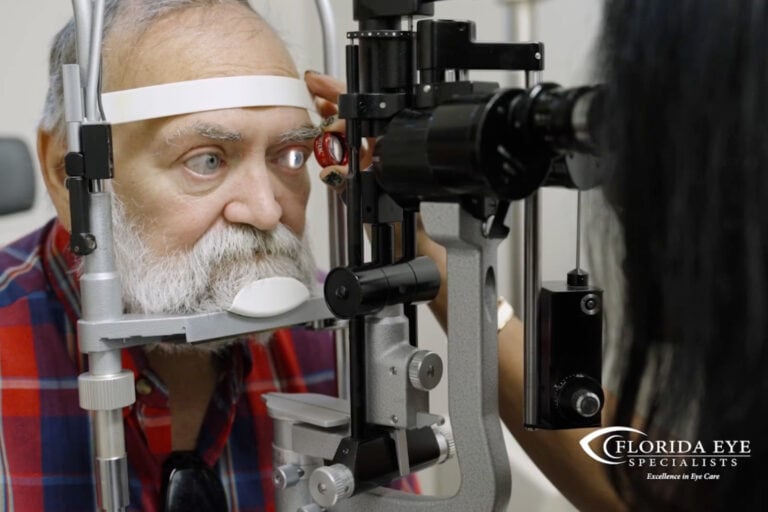
Keratoconus is a progressive eye condition that causes thinning and bulging of the cornea, leading to distorted vision. In this informative video, Dr. Rachana Patel, an experienced ophthalmologist at Florida Eye Specialists, explains what keratoconus is, how it’s diagnosed, and available treatment options.
You’ll learn about early warning signs, such as frequent prescription changes and blurry or distorted vision, and how specialized testing can detect the condition in its early stages. Dr. Patel also discusses corneal cross-linking, scleral lenses, and in some cases, corneal transplant surgery as treatment paths depending on severity.
If you’ve been told you have irregular astigmatism or are experiencing significant vision changes, especially at a young age, a keratoconus evaluation may be necessary. At Florida Eye Specialists, our corneal specialists offer advanced care for keratoconus patients across Northeast Florida.
Video Transcript
In front of the eye we have a clear window called the cornea, and keratoconus is a disease of the cornea in which the cornea becomes weak. When it’s weak, it doesn’t hold a nice round surface, but instead becomes more bulged and cone-shaped in appearance — that’s why we call it keratoconus: the cornea is now shaped like a cone rather than a round sphere. We don’t know exactly why some people develop keratoconus. Some people do have a genetic component, so other members of the family will have keratoconus, but the vast majority of patients will just develop keratoconus without any family history of it. This is a disease we actually start noticing early in life, as opposed to cataracts, which come later in life. Keratoconus mostly shows up in the early-to-mid 20s, during the puberty years of a patient who’s going to develop it. What they’ll notice is their prescription changing rapidly — they might need a new pair of glasses every six months rather than every one or two years — and the reason this is happening is because the cornea is becoming weaker and weaker and changing shape. As it changes shape, the prescription of the eye changes. So it’s a progressive disease that just happens early in your life.